What are the latest apps connecting our digital media worlds?

I wrote a post a few months ago about “tagging” (http://www.seanshadmand.com/2012/03/02/finally-audio-based-commands-that-dont-suck/) looking for products that connect our real world data to our digital device data on demand.

Regarding that, I see the opportunity for how Shazam commercial tagging technology and the Conan show technology, written about in the post will play out for the positive in the near future.

The intonow iPad app (by Yahoo: https://itunes.apple.com/us/app/intonow-from-yahoo!/id406436404?mt=8) allows TV watchers to sync up with any show on TV. It actually works great and integrates social into every show live. I noticed that when I try to sync when a commercial is on it gives a warning: “You cannot sync commercials Which is great — it knows it was a commercial. Now that my iPad is on and open, and sync is well made and works consistently, I can now see the Shazam tagging work beautiful. I don’t expect it to be very far away.

Also, regarding Yahoo, this is the second time (first with producing Burning Love, a great web only comedy series; and the second the intonow mobile app) in a matter of month I have been impressed with what they are putting out in the TV media space. They have a nothing to lose attitude and are able to take the necessary chances needed to be taken by a big company to change the landscape and lead the charge in the inevitable transition into the digital first media world. A great early indicator that they will be big players in 2013.

The difference between the US Debt & Deficit.

The super short version:

Let’s say Sam gets $50 per year in allowance (revenue), but owes his Mom $100 in “debt” after two years.  He accrued that debt by spending $100 per year. So, he spent $50 more per year  (“yearly deficit”) than he made in allowance.

2 years * $50 yearly deficit = $100 debt.


As told by others:

More depth of the difference between debt and deficit: http://ptmoney.com/us-federal-debt-vs-deficit/

Even greater detail specifc to the US economy as it relates to taxes, social security, military spending etc:

http://useconomy.about.com/od/fiscalpolicy/p/US_Debt_Deficit.htm

The History of the US Debt

Breakdown of US Debt Over Time:

Here is a breakdown of debt accrued over 40 years:

http://www.skymachines.com/US-National-Debt-Per-Capita-Percent-of-GDP-and-by-Presidental-Term.htm

Here is a picture snapshot from the site incase your feeling lazy:


Per Presidency Comparison:

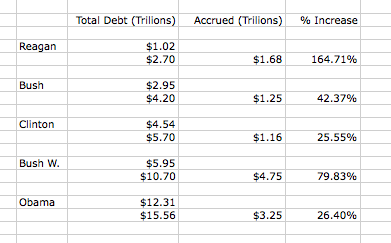
This is the total debt accrued per president in a more condensed format:


I crossed checked it with the treasury data to make sure it was kosher – you can too: http://www.treasurydirect.gov/govt/reports/pd/histdebt/histdebt.htm


Reflection:

The great thing abot history and numbers is it help remind us there is a difference between what rememebr and what really hapened.

If your going to base your opinions on these numbers and term, please know what they are, or else not only are you doing the country a diservice, but you are letting people use your naivety to control your feelings on an issue.

Opinion:

As you can see it isnt a question of president,  the larger issue is that spending more than we make has been an issue without our country as a whole for a long time. Many of us complain about the economy in a warm room with a bed to sleep onand food in our stomach. (Of course many do not, and we need to fix that too), but we spend more than we should, and then hope someone will save us so we can do it again. That might be a better issue to reflect on then the unsubstantiated blame game.

Are you part of the solution or part of the problem? Debate to improve, not to beat.

As we work together let’s keep in mind that one another argument can bring us together through learning or tear us apart through insults. Here are some tips to “keep it clean and productive” if you are thinking about getting in a debate with someone you know, or about something you think you know.

It’s not like this list is meant to be a rule book, but it couldn’t hurt to think about these things next time you get heated about issues. If your purpose is to improve, unite, progress, or fix then I strongly suggest following it. If you enjoy yelling and making claims whether or not they are true or helpful because it makes you feel good, well – you have much more to worry about then winning a casual debate.

  1. Do you truly want to improve and/or find a solution to your problems.
  2. Do you have any facts or examples to back your claims? Can you simply show the source of the facts that upset your, or that you do not agree with to allow the conversation to progress forward?
  3. Is your comment contributing to a divide, or working to decrease one between the person you are arguing with, or the group or person you are talking about?
  4. Do any of your claims contradict another of your claims in anyway?
  5. Could you make a list of your claims to show there is not a contradiction?
  6. Is your statement inflammatory and/or does it question someone’s legitimacy based on your perception of their race, ethnicity, or religion?
  7. Are any of your claims based on the fact that you think someone is out to get you, purely for their hatred of you and/or the country they are trying to govern? Do you really truly think these people hate you and want to destroy the country they also live in?
  8. Can you write down the principle of what you AND they are arguing about? If not do so, or ask them to do so. Make sure you are arguing about the same thing at the same time.


If you think everything is going “down the drain” then what is it that yelling will do to change it? What do you win if you’re right? Work hard on making a difference through learning, discussing, and finding common ground.

Why the color of your neck tie means more then all else

What I want to dive into and can’t wrap my head around yet are the 45% of people that elected the continuation of policies in the 2008 election. Hear me out. 45% of people voted in 2008 to preserve the state of affairs we were in *then*. If you can remember, we actually thought America was about to go under. It was the most scared I have been for an immanent collapse in my lifetime. It was not a Nostradamus prediction of collapse 4 years away, it was collapsing right under our feet. Not everyone can be an economist, but when we were confronted with a collapse in America, that ended up stretching over the western world, 45% of people in the US were like – yeah I can convince myself that it’s okay and can look past all of it – “4 more years!”

Where was all that passion I see now for the obvious change and disapproval needed then? Where was the wherewithal then in holding people accountable for bad policies and a brightless future? I would be far more content if the 2008 election we saw an 80/20 or 90/10 split among voters. But to have passion about creating a bright future, and arguing about the impact of the economy now at an almost equal % breakdown as then is — absolutely mind blowing. The arguments to vote for change then were dismissed by those 45% back then for a far more hopeless situation. If it didn’t matter enough in the last 10 years, why dose it matter so much now?

Is the whole country held hostage by something as simple as switching from a red neck tie to a blue one?

Have we turned politics into a sporting event where your team wins at all costs? Is it the person, the policies, and the state of affairs, or just a jersey and the opportunity to engage in heated arguments over a Poppa Johns pizza that drives us all? Sadly, the last 8 years point strongly to that fact that it is, and that is what has let me down the most. Which ever way you decide to vote now, my issue is with consistency and perspective. What would YOU say to YOURSELF if you went back in time to only 4 years ago? Would you have to change what you were passionate about now just to agree with your former self then? I don’t know how this election will turn out, but I do know that there is a far greater problem in America, the lack of objectivity, and a passion to *find* issues to leverage for the benefit of an election, and not the need to examine an issue for the sake of true, united, prosperity.

Here is one project that could help… Write down what you are so mad/passionate about in this election. Write what you expect and want, and where the failures are that you feel so strongly about. Put them in a box, and read them every 4 years before an election. If Mitt does well then honestly great – I want the *country* to succeed be it by a black, white, or green president. But if he does poorly will you have the objectivity to see it? Or will you make excuses and change your passions so your team, not your country, can win? Will you blame *bad* performance on the last president, would you blame the *great* performance on the last president just the same?

(And don’t be so cocky about how it would play out. 45% of you would have already been screwed if you stared this project only 4 years ago!)

Look, believe what you want, but a great america actually starts with you – not the president.

A great politician will become great at being elected, a great business man will be great at making allot of money for himself, and a great citizen will do what’s best for them and their neighbors. It is tough to trust that all three will work perfectly for one another with such different objectives driving each of them. The greatest side to have faith in and support is, and always will be, the citizen’s side. If you are picking a side, pick our side, the non elected, non-special interests side – the peoples side.

The greatest impact made is not from someone elected, but from those that elect.

Please, keep sports out of politics.